
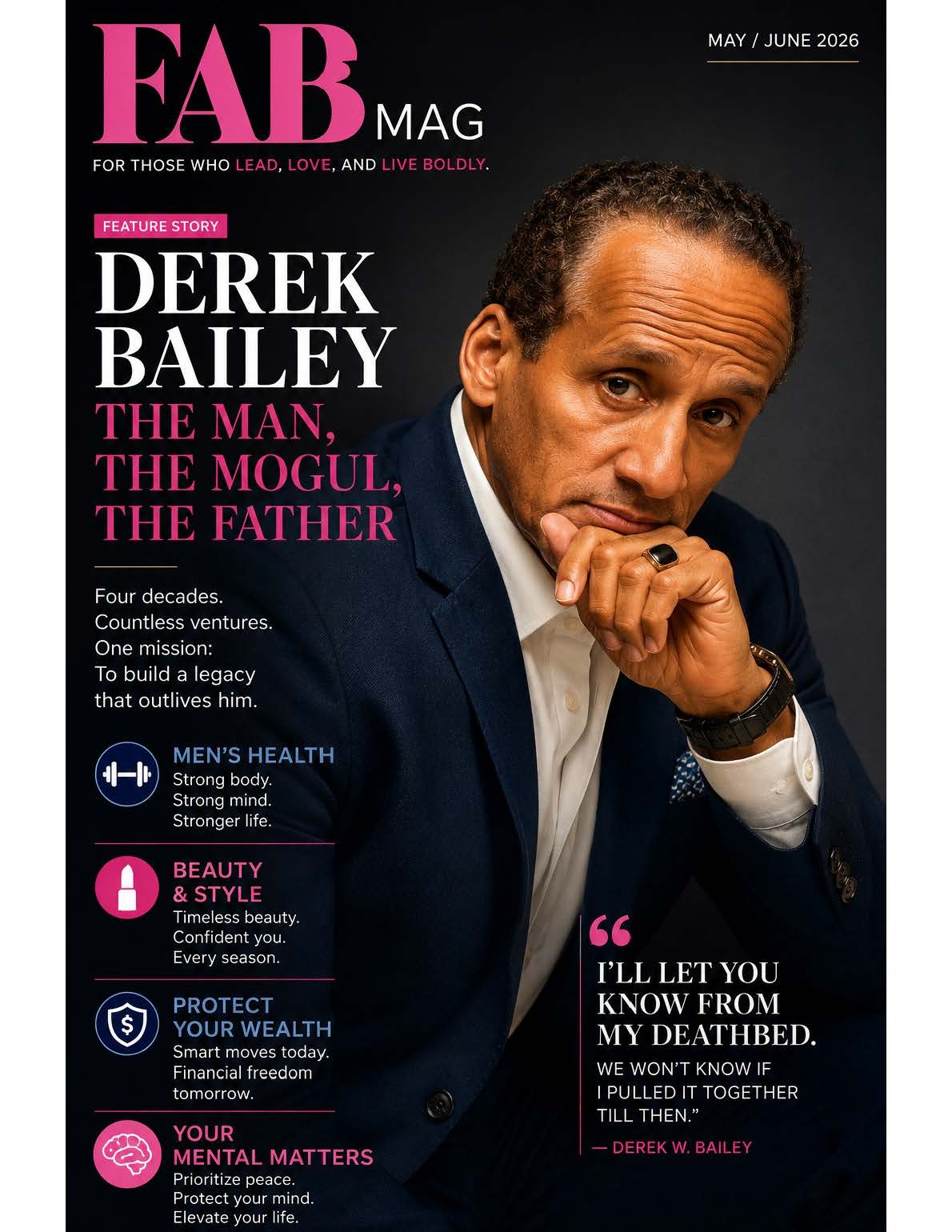


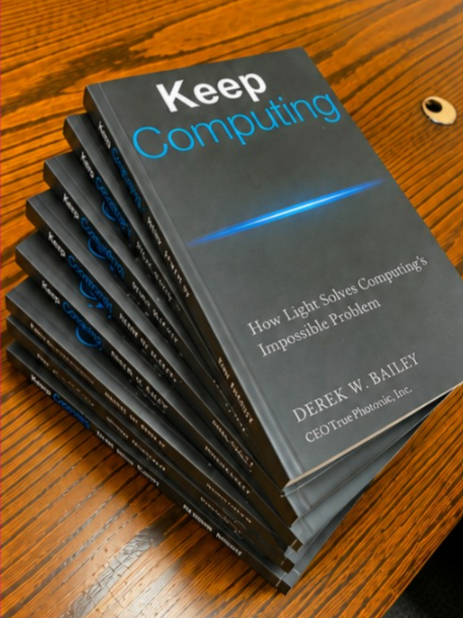
Derek W. Bailey is the founder and chief executive of True Photonic, Inc. and the author of Keep Computing: How Light Solves Computing's Impossible Problem.

FOUR DECADES, A STRING OF COMPANIES, AND A COMPUTER THAT RUNS ON LIGHT. DEREK BAILEY, FOUNDER OF TRUE PHOTONIC, WILL TELL YOU NONE OF IT WAS EVER THE POINT.

“I’ll let you know from my deathbed,” he says. “We won’t know if I pulled it together till then.” 

He means it, which is the first surprising thing about a man photographed in a sharp suit for a magazine cover. Bailey is here because he founded True Photonic, Inc., a company building a way to compute with light instead of the electricity that silicon has run on since the start. If it works at scale, it changes how the most powerful machines on earth get made. Behind him is the sort of resume that gets a person reduced to the word visionary: forty years of companies, a few of them first of their kind. He has heard the flattering words for a long time. He has learned to distrust most of them.

The story Bailey tells about himself does not begin in a laboratory or a boardroom. It begins in a small apartment in the 1990s, where he was twenty-eight, mostly broke, and a single father. Everything that came after, he says, was an argument with that one fact.

There is no romance in the math a young single father does, and Bailey did it every month. A child eats tonight, not next quarter.

“Their stomachs don’t care about a bad market or a bad day,” he says. The lights stay on, or they do not. The coat fits, or the kid is cold. He found in that arithmetic a teacher more honest than any he met in business. It could not be charmed or rescheduled. Something happens to a man, he argues, when the people depending on him cannot be reasoned with. Fatherhood done honestly stops being one role among many and becomes the whole working definition of manhood. It imposes a discipline no one would choose. “You can’t negotiate with a fever at two in the morning,” he says. The steadiness he is proudest of was not, he is quick to say, his own invention. His daughter required it of him on the days he had the least of it to give.

What a magazine would file under career, Bailey lived as a long sequence of bets placed while short on cash. He spent some years doing business in Asia, with his mother and family helping to raise his daughter in his absence, and then came home to start a temporary-staffing company. He drove as many as 200 miles a day, cold-calling for accounts and building it into a multimillion-dollar business that his family runs to this day. 

The profits bought the next idea. By 2002, he was installing ad-supported video kiosks on the Wildwood boardwalk, on streets in New York, in a Moscow mall, in Colombia, and Puerto Rico, letting passersby place a long-distance call for nothing over a form of internet telephony most Americans had yet to hear of.

Then came an engine company, and a car company to put the engine into something, and for a period, his Derek Automotive stood as the first Black-owned electric-vehicle manufacturer in the United States, undone in part when tariffs hit the suppliers it leaned on. He expects to see that idea come back before long, he says, this time as a robotaxi running on the back of a photonic brain.

"I'LL LET YOU KNOW FROM MY DEATHBED. WE WON'T KNOW IF I PULLED IT TOGETHER TILL THEN."

None of it, he says, felt like arriving anywhere. It felt like grinding. The secret every builder he respects will admit once the recorder is off, Bailey offers on the record: the money comes and goes, flush one season and lean the next, and the grind is nearly every day in between. The celebrations are real and few, and usually spent worrying about the next payroll or funding round. This is why the word on the cover sits wrong on him. A mogul, in the telling, is a man who has already won. But the telling only ever counts the money, and the market, and a life keeps other books. Was he proud of what he did to get there, or did the methods cost him something he keeps quiet about? Do his principles still answer when he calls on them? Does the person he comes home to love him?
Bailey says he doesn’t know the inside of most people’s lives well enough to be sure he has ever met one.

Bailey has a theory about where a father’s self-respect comes from, and it arrives in two installments that feel nothing alike. The first is early and uncomplicated. You provide, and there is a plain satisfaction in knowing the people you love ate because you went and earned it. For years it is enough. 

The second installment is harder. The children grow up and grow sharp. They begin to see the whole man, the temper, the bets that went to zero, and the easy pride of the provider is gone, because now there is a witness who knows better. There is no buying your way past a child who has watched you that closely. 

What is left to earn is their respect after the myth has burned off, and it comes the slow way, in person, on the ordinary days when nothing is on the line. 

“A man is a father trying to impress his kids until he dies,” Bailey says, and he places himself, like everyone he knows, somewhere in the bottom to middle of that work.

The Sentence on 1-95

He raised daughters through all of it, one in his home and one in her mother’s, each turning formidable in her own register while he was busy being five steps ahead of one market or another. 

The home keeps no quarterly calendar. The boardroom day ends, and the homework and the scraped knee and the hard question about the world are waiting, and they want an honest answer. And there was the drive to the other household, the lift of arriving, and the particular ache of leaving again. His older daughter, Alexandra, is a political strategist and coalition builder, and her work runs to policy and to advocacy for survivors. The conversation Bailey keeps returning to happened on a drive down 1-95, Alexandra in the passenger seat, talking about his own long campaign to bring photonics to market and how slowly any institution or market ever agrees to change. He has spent her whole life proud of the way her mind works, and a little outpaced by it. Then she said a sentence he kept turning over the rest of the drive, and wrote about on his Substack the next morning. “One day soon, everyone will have been against this.”
She meant the data centers, the power-hungry kind being pushed onto communities that never asked for them. And she was speaking in the future perfect, a tense Bailey could not stop seeing once she had used it. 

It is the grammar of people who can make out where a thing is heading but will not stand there yet, who keep the safe distance of will have until the verdict is safely in, and who will, once the harm is plain to everyone, recall having opposed it from the beginning. Bailey has met that posture in every industry he has entered. A cleaner engine, a different kind of transit, a computer that runs on light: each was impossible right up to the moment it was obvious, at which point the same skeptics slid into the past tense and remembered believing all along.

Alexandra was naming the caution of comfortable people, and without meaning to she was describing the weather her father has worked in for forty years. She did not make him into anything on that drive. She handed him a clean word for what he already was. The daughter he had once driven two hundred miles a day to provide for was, somewhere on that stretch of 1-95, quietly providing for him.

A World Worth Handing Over

That is the frame Bailey brings to the bet he is placing now. True Photonic is building machines that compute with light, and he will happily skip the physics in a Father’s Day profile. What he will not skip is why a man who has moved between industries his whole life refuses to move on from this one.

The technology business, as he sees it, is sprinting with its eyes shut, throwing up vast data centers and ever-hungrier systems to feed them, drinking power and water at a rate few want to quantify out loud, and filing the cost under later.

Bailey has trouble with later. “I have daughters,” he says. “Later is the world I’m going to hand them.

True Photonic, he says, is being built to do the heavy lifting of modern computing on a fr11Ction of the energy, on the theory that you do not get to burn the house down and call the smoke progress for the children who have to live in it. The core physics has been measured independently by people with nothing to gain from flattering the company, and it is fast. The rest is still being built, he says, in the open.

Then he corrects the cover one last time. If there is a mogul in the story, Bailey insists, it is a roomful of people, not one man, and the ones he names are fathers, everyone.

He starts with Del, who has built beside him for twenty-seven years, and keeps going: Gary, Carlos, Jefferson, Roy, Seth, Jerome, Sage, Mike, Steve, Walter, Orrin, Chuck, Mark.

“These are the men making what happens happen,” he says.

Every one of them, he points out, shuts the laptop at night and goes home to his own kids and his own version of the arithmetic Bailey started with at twenty-eight. There is no single great man in his account of it. There is a room of men, a great deal of grinding, and a shared refusal to leave the place worse than they found it. Bailey’s company runs on one conviction about light: that it clarifies, cutting past the noise to show what is actually there. He has come to measure a child by the same standard. The return on a son or daughter was never going to arrive as an exit or a valuation. It comes years later, in a person who thinks more dearly and carries a firmer moral line than the parent who raised them.

He wrote a book this year, Keep Computing, so the full argument would sit somewhere a reader could pick it up and judge for himself.

The book is not the legacy, he says, and neither is the company, and the money, least of all, since it behaves like weather. What he is after is the note at the end, the one he keeps promising to file from his deathbed. The truer version of that note is the one his daughters might find worth reading.

For most of his life, he admits, he was not sure how big a legacy he could leave. This bet, the one that runs on light, is the one that makes him think it could leave something amazing.
I've Been You

Asked what he would say to other fathers, Bailey splits the answer by age.

To the young man, he gets close to the bone. “I’ve been you,” he says. “If you’re Black, especially you.” Study the men who have given themselves over to raising their children, he says, because the same things keep turning up in them. They carry themselves stronger. They seem surer of who they are. They are better to the mothers of their kids, and they build tighter brotherhoods with the other men doing the same work. “Run toward what your kids impose on you.” He admits he did not always run toward it himself, and that without his mother and his family taking up the slack, his own story might have come out dimmer than it did. Let the children become the center, he says, and something hard to fake settles over a man. People begin to trust you. Doors you were not even knocking on start to open.

To the older fathers, he is level and a little gentle. We did what we did, he says, and some of us did it better than others. He does not treat that as the final word. “If you’re still breathing, the fatherhood game isn’t over.” There are wins left to get, in his telling, and amends till worth the trouble.

He keeps his own measure for the word on the cover, and it has nothing to do with being a millionaire or billionaire. “If I could have kept the wife, and raised the kids, and given them the time they needed, and never let them down by my own doing, and protected their and my health, and helped my community in meaningful ways, and been there for family and friends when they need me,” he says and been there for family and friends when they needed me,” he says, “I might call myself a mogul.” He did not run the table on that list, and he knows it, so he leaves the title where he found it. By his own accounting, he is a man who spent four decades and a row of failed and half-failed companies, with a few big successes among them, trying to provide first and stay worth respecting after.

Everything he built will be somebody’s footnote one day. The only thing that was ever fully his to make is out in the world now, two women changing it on terms he did not set and could not have drawn up. “That,” he says, “is the breakthrough.”

The rest was the work he did to be in the room when it happened.